Thursday, 13 January 2022

Faith and politics part 1 - The passion and fears of creationism


I am a Christian, a minister in the church, and I have a scientific mindset (from school I went to University for a degree in Biochemistry and Microbiology).   It is not for me to comment on anyone else’s relationship with God, but I do feel able to comment on what others say about God and how it relates to my encounter/view of God.

How did it all begin? The Bible gives 2 versions of creation – the first based on 6 day creation and where God proclaims all to be good, the second giving a story of the first man and woman breaking God’s command and giving a reason for the challenges of human life – working for a living out of the soil. 

Scholars who look at the texts, and the use of language in the Hebrew, including the words used for God (Yahweh vs Elohim), see that there are different voices in parts of the Old Testament – coming from competing traditions.

Since Darwin raised the theory of evolution parts of the church have reacted by insisting that these early parts of the Bible must be taken as literal truth. This was not the case for generations before that. Not to say that people didn’t take Genesis at face value, but there was no insistence that it had to be literal and many took it as a lesson in matters of faith.

Today there are those for whom the literal truth of Genesis is crucial to their faith, and billions are spent on producing resources (including visitor attractions) to proclaim this ‘truth’.   They seek to defend their position by claiming science backs them up, and in doing so they tie themselves up in ever tighter scientific knots.  They defend the young earth theory of 6000 years, in the face of geological and fossil records that date our world much older – in billions of years. Some will allow for a day being a thousand years but that only doubles the brief time.  

I recall as a teenager going into my biology class with a book debunking evolution and asked to sit out that lesson – and was in the prep cupboard.  I did do the reading for the exam however. I didn’t come from a strict creationist church but had absorbed a particular book that led me to these actions.  I wish I could go back to Mrs Evans and explain why that view was something I let go shortly afterwards.

The struggle for young earth creationists (YECs) is to make science fit a poetic/fable view from a book of theology. So yes all things created in 6 days, with dinosaurs arriving the same day as humans, and trying to merge in a different story about Adam and Eve. But then Cain kills Abel and is banished to wander the earth with a mark on him that he should not be killed – by whom? Who else is out there when they are the first children of Adam and Eve?

Then we come to Noah – how to defend a story as a global flood rather than a local event that passed down in tribal memories? YECs have to theorise how the earth can be drowned up to Everest when there is not enough water on the planet to do that, but their main focus is about how to justify the ability of the Ark to carry all the different animals. This amounts to reducing the massive number of species to a smaller number of ‘kinds’. But then they say that in the less than 6000 years those kinds can expand into many species, basically requiring an evolution at a massive speed that has never claimed by evolution.   (See here for a youtubechannel by a Primatologist)

Why do some Christians feel the need to insist on one specific understanding of the first 11 chapters of the Bible? And in parts of America to demand that creationism is taught in science, whereas in UK I have not heard of that, whilst creation may be part of the RE curriculum.


My impression is that those who seek to defend a literal 6 day creation and Noah’s flood are people whose faith in the Bible as a whole has become entrenched in the concept that every word of it is God breathed, by which they mean a form of automatic writing with God directing every word and all punctuation. They often (for English speakers) see the King James Version of the Bible as the first so most perfect English translation, despite it being neither the first in English, nor the most accurate. Many manuscripts have been discovered since KJV and the translation had political leanings to defend the status of the monarchy, it was also using a dated language even when new.

For those who see every word of the Bible as God dictated, the status of the New Testament and the stories and words of Jesus need the Genesis accounts to be literal truth too.  If one were to be not literal truth then the other would also fall, if creation was not 6 days then Jesus could not be their salvation.

 This seems to be the core reason for their desire to argue for a singular intepretation of the first Biblical chapters and the absolute fear of any other truth.  They have based the core of their faith on a word by word truth of the Bible, and in the young earth theories fall, then so does the basis of their faith.  They must therefore defend creationism with all they have.

This deep commitment to a single view of the scriptures, and a fear of any other point of view leads them to see only creationists as valid Christians, and the need to expend a lot of money to try and convert others to YEC and their ‘true faith’.  Even so it would be a matter for themselves, except that it has powerful impacts on politics within a powerful nation, that is for another post.

This is not the faith I find in my Bible, I find fables that speak of God’s ways, I find people trying to understand their relationship with their God, and through that I hear the voice of God, not through dictation, but through the experiences of other God followers.


Saturday, 21 November 2020

Bullying - a curse beyond the playground

 Bullying is insidious. It is an attack by a thousand cuts. It belittles and undermines, it gradually wears the targeted person away until they are the shadow of who they once were.  Yet at the same time each action is seen as so small that alone they would not be considered significant. But cutting again and again causes deeper longer lasting wounds.


I cannot remember a time in school before I was singled out as someone to be teased.  There we go - words that undermine the intense power of bullying, 'just teasing', 'kids will be kids', 'it's only a joke'.

What decides who will be the focus of a bully? Someone different from the rest, someone perceived as weak, someone maybe seen as a threat that a bully wants to stop, it can be so many things. Maybe it also depends on the context of the bullying, childhood or adult, by those who should be your peers, or those with power over you.

Back to school, primary and secondary, right up to leaving the upper 6th. By then my year group bullies had either left or grown out of the worst, but younger year group lads had taken up the slack.

I wasn't beaten up, no bruises to show, and yes I am grateful for that, yet it also made it hard for me to complain or prove what was happening. It even made me feel I had no right to complain or be bothered.


Yet it is the verbal bruises that don't heal, 'no one will ever like you', 'no one will be your friend'. When you are told something day in and day out for years it gradually becomes your inner voice too. Even stones are worn away by the continual drops and flow of water.

Once a bully has the power then even things that would sound like a neutral act come with sinister messages. I clearly remember the day in my mid teens when this dawned on me. I had been encouraged to 'tell' on examples, but when a bully says hello to you in a way that is threatening, a reminder that they are there, the look in the eye etc.   But what can I report, that 'he said hello'?

And that brings us to bullying in the workplace, governments, or churches. Sometimes it is a targeted attack on individuals, sometimes it is an overall culture that is more indiscriminate in the aggression shown.

As with the Priti Patel, Home Office, case it takes great courage to speak out about bullying. You know that they will twist each individual cut, 'just banter', 'need to toughen up in this workplace', 'you are just being oversensitive' and the current fashionable one 'don't be such a snowflake'.

Yet again, as in so many contexts including too often the church, even with evidence accepted as valid no one has to take responsibility. In many organisations it is a case of no one wanting to rock the boat. In church contexts, which I see though those I know and also through union work, there is a lack of courage to challenge bullying behaviour even when it may have driven away several ministers in a row.  Or where a senior minister affects others.  Bullying can come from any side, and those targeted can be of any type.

There is malice intended in some cases, a deliberate targeting of someone or a certain group. But yes it can be unrecognised by even the bully themselves, this does not excuse behaviour and attitudes to others that consistently and significantly damages them.  If someone is left emotionally crippled and suicidal by your actions then you have responsibility for those actions, and those words.

And among the greatest lies ever taught to us as children 'sticks and stones may break my bones but names will never harm me'. 

The truth is 'stick and stones may break my bones but names can break the soul'. 

There are many reasons I despair at our current government, but standing up for someone who has been found through independent review to have used bullying behaviours, shouting and swearing at workers in her team, is definitely one of them. But then I know all too well that we in the church structures have a plank in our own eyes too.  And that is cause to weep. 

Monday, 16 November 2020

Faith, and spiritual abuse


I am a church minister, I am part of the union for faithworkers and a rep, I have raised the issue of problems with the system to deal with discipline and complaints within the UK Methodist Church.  I have been part of a multifaith conference discussing spiritual abuse, where religious beliefs are a cover for un loving and even abusive attitudes.

Why? Because I have personal experience of bullying within my faith community, because I have known others to also suffer, because the systems to report this fall way, way too far short of facing up to those who bully in the name of faith.

I am a church minister, I have mental health struggles. I want to lobby for proper understanding of such issues. I have encountered those who gave me permission and acknowledged that mental heath wasn’t a failure. The student from another church in the circuit when I was at uni who spoke about being a Christian and depressed was the first step in that, and I cannot recall her name but spoke to me before I would ever have admitted to my own issues.

I have encountered a big barn church near here that sells a booklet written by its retired minister that says depression is self pity and that Christians should look to Jesus and reject psychology and psychiatry as of the devil (since Jung and Freud were not Christian).  Sorry but psychiatric care and medication are what enable my stability, and would they ever dare to say the same for physical conditions like cancer, even if those who discovered medications are not Christian? (And by the way psychology has developed way beyond Yung and Freudian ideas anyway).

Then I hear that decades ago, when alone in a distant place, someone close to me who was experiencing wobbles in their faith journey, and went to the person who was there to support and help was told that if don’t feel that fit the Christian mould then going to hell. Knowing that this person came home suicidal, that surviving attempts on their life they then lived decades feeling unworthy of God’s love….     All my understanding of spiritual abuse is clearly there; all the failures to understand not just mental health but the normal ebbs and flows, stresses and strains of life, all the failures I have experienced in the church, and through others’ journeys, are encapsulated in that one dismissal of a hurting person.   I wonder if that person who listened and replied in such a way went home feeling that they had testified to God’s Word and therefore had had a good day at work? Yet they left someone feeling that they could not be good enough for God and suicidal.

Matthew 18 v 6-7

“If anyone causes one of these little ones—those who believe in me—to stumble, it would be better for them to have a large millstone hung around their neck and to be drowned in the depths of the sea. Woe to the world because of the things that cause people to stumble! Such things must come, but woe to the person through whom they come!

 Sadly such millstone bearers are all too common in our churches and in our structures. And our structures are too scared to call people out – keeping the peace being held as more valuable than calling out injustice, bullying, causing others to stumble, and even to the point of collapse.

When we sit in our church buildings and wonder where the people are we need to ask ‘what sort of God have we revealed to them?’, ‘how have they been hurt by the church, by Christians?’ and ‘what in our life as church is strong enough for them to dare to trust us?’

I believe in God who has been part of my journey, through physical and mental health iussues. I give thanks for those who were there to say that I was not alone and without trying to fix me. I could not always sense God with me, but I was not judged in that uncertainty, others held me in their faith when I could not trust in my own faith, because I could not process my own chaos.   

Yet so many are not held as they are, but told they need to show their faith in a certain way. As with the person I referred to, this can leave wounds open for years, people spiritually abused by those that should be there to support them.  Sadly it is more common than we like to admit.  


Wednesday, 11 November 2020

What is truth?

 What is truth? So Governor Pilate asked Jesus when the crowd cried for his death with no evidence of wrongdoing.


It was also the text of my first ever sermon when I was a university student and training as a lay preacher within the UK Methodist Church. Normally you start by sharing parts of the service with your mentor but since I came to the planning meeting with 3 points I got given the sermon.

I can't recall what I had to say about it, though somewhere I may have a floppy disc with evidence.  However it is a powerful question that is very important today and in the light of the US election of Nov 2020 the issue of truth versus claims is critical.

By a coincidence of scheduling this past week as well as bringing the US election count brought the BBC programme about lies in history. How many of us 'know' that in the French Revolution Maria Antoinette said of the hungry masses 'Let them eat cake' - except apparently she didn't. And the storming of the Bastille was not a grand liberation of political prisoners but 7 random men, and that actually the revolutionaries worked with the monarchy and elites for a couple of years before killing them. 

So to the 2020 US election - despite the rampant claims of the Trump loyalists, that there has been fraud on a massive scale, no evidence has passed muster in any of their legal claims. Yet the reality seems meaningless to upto 20 % of the American population.  80% of Americans are reported to accept the result of a Biden win, which leaves 1 in 5 still in doubt despite the thousands of votes in favour in each crucial state. In past election reviews the number of votes changed/removed were in the tens or just about 100s whilst the vote in favour of Biden was in tens of thousands.  

But what is truth? Is it the people who shout the loudest? No smoke without fire and all that. If one person can cast doubt on the truth as recognised by every other channel, where is our sense of truth?  Is truth about evidence or who shouts the loudest? Is doubt overwhelming even when it is proven wrong? 

 What about those accused of wrongdoing? It is embedded in our understanding of justice that we are 'innocent until proven guilty', yet the culture of trial by social media is such that someone is guilty by any association with someone else who is vaguely linked to a crime. 

Surely truth has a value of its own - not about claims but about evidence, but then as history is written by the victors in their own image we now seem to have arrived at a point where 'current reality' is now written as 'those who shout loudest'.  Maybe it was ever so, but the wider range of the loudest voice through modern technology brings a louder voice, regardless of what is actually truth.


Friday, 30 October 2020

How did conspiracies come to claim our world?

 In a rural area of West Yorkshire, just up the road from a chaple I work with, there is graffiti on the road #QAnon.  If you have not yet come across QAnon then let me introduce you - it is a an internet group that  promotes a range of conspiracy theories, especially that Trump is the appointed one to unveil a paedophilic corruption across all other groups in politics and entertainment and finance.   They follow the revelations of Q, with no idea who Q is or whether it is even one person.

It doesn't seem that long ago that conspiracy theories were confined to the loner, the rare person disconnected from wider society, seen as weird and definitely not mainstream. Today however we find people citing conspiracy theories in every local community facebook page, denying science and seeing everything as a matter of state control.  

How did this change happen?

Lets look at history, how the status of 'those who know' was for a long time the leaders of the church (Catholic only at that time).  This was partly challenged in the reformation, but still authority was rooted in faith. Then came the scientific renaissence, this started as people of faith exploring their world, but then came into conflict with the religious ideas of the time.  

From then science began to take the voice of authority to culture, not all at once but by the 20th century science was seen as opposite to faith.  The promise of science was that knowledge will continue to grow and in time explain everything and have the answers to all the problems of life.

Late 20th century and into the 21st we have found that science has not had all the answers, and has not fixed all the problems. There has been cultural disillusion with the faith in science, and we have reached the point where that trust has crumbled to the point where science is not only not trusted as the answer but is even seen as false. 

Then every point of authority becomes something to doubt - and fake news is as valid as that with factual basis. Evidence that has witnesses backing it is dismissed as biased, and any conspiracy view is seen as worth equal exposure, or even more valid.

The irony is that science never claimed what people expected of it. As someone taking a science degree in the 1990s I can testify that scientists only saw their views as 'the best interpretation so far' where it is always open to being reviewed and even abandoning if new information emerges. 

Now we are here in 2020 - faith was dismissed a century ago, and now science has let humanity down as it has not stopped bad stuff happening. I think the rise of conspiracy theories is rooted in this loss of trust in any of the former authorities. In a pandemic where the voice of science is being heard it is immediately distrusted, not becauise of other relevant data but simply because anything said by science is assumed to be untrustworthy.

Meanwhile human nature seeks meaning, reason, some intelligence behind what happens to us. It is why people will say in the face of struggles 'everything happens for a reason'. Some take that on a faith basis - 'God has his reasons for this', for others it is the sense of the power of the universe.  The idea of randomness is too scary, and also suggests that we cannot control our situations.

So the conspiracy theories - if you cannot trust God and cannot trust science yet believe there is a reason, a mind, behind the problems in life, then who do you blame? It makes people vulnerable to groups claiming they know who is at fault, who has an agenda, who is manipulating the masses and there are plenty of those seeking to fill that vaccuum.  

Suddenly the conspiracy theorist is just down your street, claiming there is no Covid illness, that mask wearing is not care for our neighbours but a deliberate attack on rights in order to control us.

Is there corruption in power? Probably, the temption to support those like you is always there.  Are there failures in political leadership? Probably, there is no such thing as perfection.  Does this mean that there is a complex set of groups working together for a single master plan in our world? Don't think so, that would take a level of co-operation and planning that is beyond what our leaders are likely to manage. I was once told 'assume incompetence before conspiracy', and that is where I stand.

I believe in the place of science, whilst recognising its limits and constraints. I am a person of faith whilst respecting that this does not give me the authority to tell others how to live. I am frustrated by the politics of our times and the impact on those in need, but do not see any master plans at work, merely human failures, as I live with my own failures. 


Tuesday, 27 October 2020

Your God is too small


Your God is too small - Churches breaking Covid guidance

At the end of March churches closed along with almost every gathering place in the UK.  Since the summer we have begun to reopen – some churches, with careful planning, covid risk assessments and measures.   Some are not yet open, those that are open follow careful guidelines to protect us from spreading even if someone carried the virus.

In the meantime we (the church in general in its many forms) have discovered online meeting – by broadcast or interactive methods; we have supported people through phone calls and doorstep distant visiting.  We have conducted funerals, offered recorded school assemblies, delivered worship resources to those not online, supported foodbanks and much more.

The Welsh ‘circuit breaker’ lockdown includes three Sundays – just three. Yet one church at least has refused to comply and then claims persecution when neighbours reported their gathering and the police arrived to investigate.   Police who allowed them 5 min to finish their service; police who did not fine them although they had the right to.  Whilst the misnamed Christian Concern have made lockdown closures a matter for legal action, in the name of ‘church leaders’ which turn out to be a very select few.   Comments on their facebook posts give worrying insights into a paranoid faith, suggestions that zoom is not worship, that only in gathering face to face can God speak to the church.

When a few individual churches and their leaders cry persecution for being asked to close their buildings to help public safety I think they have too limited a view of their faith and of our God. When they complain that they are being prevented from worshipping they show that they do not understand that worship is not dependent on being physically in one place. Many of us have learned how real online meeting can be, more than virtual.  Would we like to be back to life BC – Before Covid – with songs of praise, hugs over coffee, face to face church? Of course we would, but that is not where we are.

We are in a place where wearing masks show care for those we may encounter; where living with restrictions is part of love for our neighbours, a willingness to walk with others.   If being treated the same as all other gathering places, as all other faiths is called persecution then what are you saying about your community?  Those who claim special rights for the churches place themselves aloof, separate, thinking they are better than the people they live among.  This is not the way of Jesus, this is not my understanding of God.    I prefer the Zoom Blessing

Your God is too small

When you say that only meeting in person is being church

        Your God is too small

When you say that you need to sing to worship

        Your God is too small

When you say you have been banned from worshipping

        Your God is too small

When you plead persecution rather than care for your flock

        Your love is too small

When you fight against public safety to score points

        Your love is too small

When you think you are above the law

        Your love is too small

God came among us as 'word made flesh'

        How vast is the love of God

Jesus sat with the marginalised, the vulnerable

        How vast is the love of God 

God's Spirit is with us in all places and times

        How vast is the love of God


Wednesday, 10 June 2020

Orpah, the other woman in the book of Ruth

The book of Ruth in the Bible is 4 chapters but quite a complex story, and involves various aspects of the culture of the time that may seem odd on first reading around kinsmen marrying widows etc.

It has a quote that is among the most treasured for many. When the widow Naomi decides to leave the place the family fled to in a past famine and return to her country at Bethlehem she has two widowed daughters in law who were Moabites, local women from where they had taken refuge.  She tells them to go back to their mother's homes but Ruth clings to her and says - 

'Don’t urge me to leave you or to turn back from you. Where you go I will go, and where you stay I will stay. Your people will be my people and your God my God. Where you die I will die, and there I will be buried. May the Lord deal with me, be it ever so severely, if even death separates you and me.”


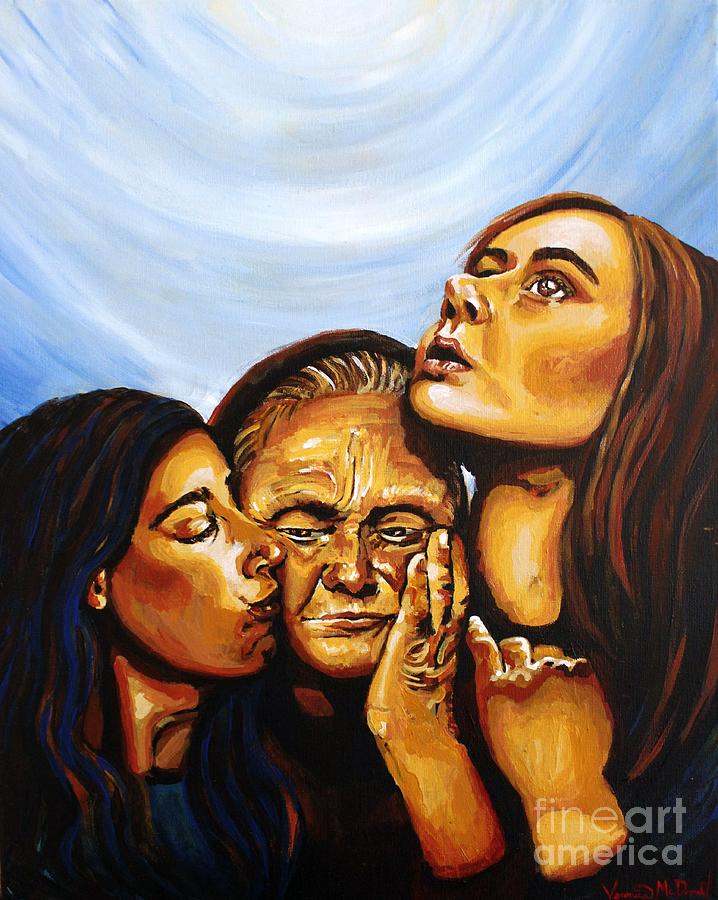
Ruth Naomi and Orpah Painting by Veronica McDonald
https://fineartamerica.com/featured/ruth-naomi-and-orpah-veronica-mcdonald.html
A quote that has been used to speak of commitment, love and loyalty.  But what about her sister in law Orpah, the other woman in the story who does go back to her own family? 

The book of Ruth is the focus for 'Bible Month' 2020 and so many churches are looking at it and considering its message. As part of a day of reflection for our staff team led by Dr Rachael Starr (tutor in Biblical Studies at the Queen's Foundation, Birmingham) we were asked to imagine a letter to one of the characters in this story.  These are my thoughts addressed to Orpah - 


Orpah,

You and Ruth accepted this family of outsiders, of economic migrants, coming to your country with nothing, adding to the mouths to feed. Famine knows no boundaries, was life tough in Moab too even if better than in Judah?

But you were willing to mix with them, so much that you married one.  What did that mean for you? Was it love, surely it would not have been seen as an advantageous match for you? Or was there something that left you without options in your own people?  Or did the family take you and Ruth so that they would be more part of your community, more integrated, assimilated, accepted?

What did it mean for your identity to marry the immigrant?  Could it have been a blending of cultures? Or did you have to set your Moabite ways aside? Were you claimed by the immigrant faith, did it shape you within or just hide your own ways?

And after your widowhood, your sisterhood with Ruth, when your mother in law decided to leave your country, what then? Legally bound together, setting out on the road, then a choice.
‘Go back to your mother’s house, find a new husband, a new future there’

Was it a warning, had you considered the implication of being a Moabite in Judah, where Moab was seen as the enemy the pagan, those who tempt Godly people to wrong ways….?
Was this behind Ruth’s pledge to take on Naomi’s faith and her God – to be as little Moabite as possible, to deny her own roots in order to be more acceptable, to have a better hope in Bethlehem? 

Yet in the Bethlehem fields she was just called Moabite, foreigner, ‘not one of us’, even with her commitments she faced the prejudice. Only because she supported Naomi, working in ways the older woman’s body would not, is she praised – valued not as herself but for the sake of another who IS one of us?  Only to be protected from assault because of Naomi?

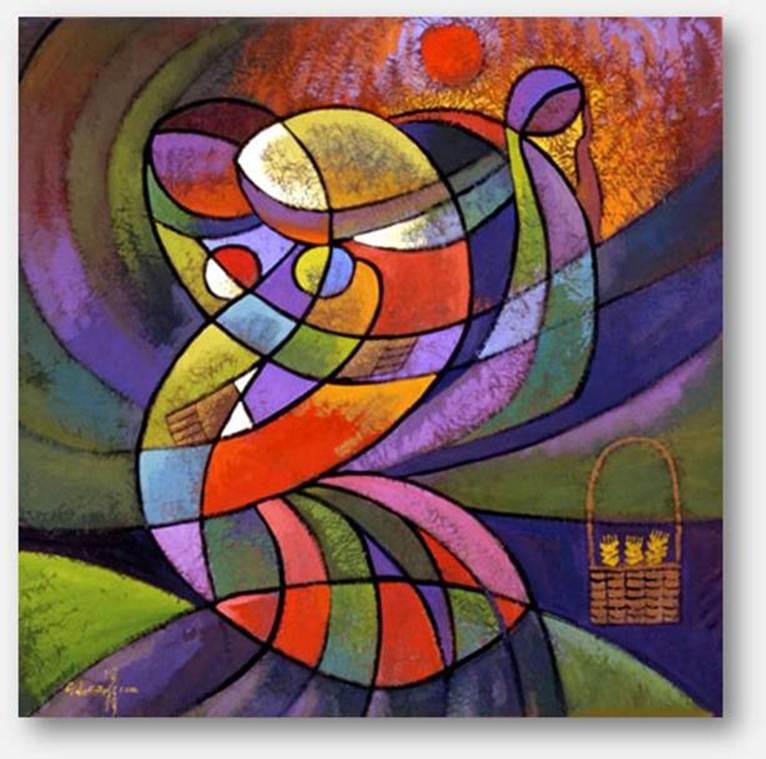
By He Qi info here https://pages.stolaf.edu/lagerqui/d-chaidez/
Did you glimpse this ahead? Did you glimpse the future of being ‘redeemed’ being married off to a relative without choice following the laws of Moses, this culture you were not born into?

You chose to turn back, to go to a place where you were not a foreigner, where people would remember you as a child, would know your kin, your place among them.  But was it that easy?

As Naomi and Ruth travelled with each other you travelled alone, as Naomi would be able to testify to Ruth’s story as a widow, you travelled alone.  Explaining your story alone.

Was there an embrace? A welcome home of the prodigal? Or were you treated as tainted by your time in the family of outsiders? 


Were you seen as a burden – married off to be someone else’s responsibility but now back looking for provision in your birth family.  Someone who would be unwanted by any other ‘decent’ husband now, a reminder to everyone of the immigrants, that they may be glad to see the back of.

Were you now neither of your people nor Naomi’s people? Caught inbetween? Whereas Ruth chose Naomi’s people, faith and future over her heritage, did you wrestle with what it means to be in the gap? Forever changed and yet all things at once – a Moabite woman; a wife of the people of Judah – did you feel the tensions in your own heart? Or did you find your voice as yourself, as an individual? 

Was that voice heard, rejected or ridiculed? Were you silenced or did you bring something new to the community of your ‘mother’s house’?

I wonder, I wonder…..